GLP-1 drugs and alcohol: do Ozempic and Mounjaro actually cut your drinking?
It started as an anecdote too common to ignore. People who went on semaglutide (Ozempic, Wegovy) or tirzepatide (Mounjaro, Zepbound) to lose weight kept saying the same strange thing: they stopped wanting to drink. The wine at dinner lost its pull; the craving that used to arrive at 6 p.m. just… didn’t. For a long time that was all it was — a viral pattern with no trial behind it. That has changed. GLP-1 receptors turn out to sit in the exact brain circuits that assign reward to alcohol, rodents given these drugs drink less, large real-world datasets link GLP-1 use to fewer alcohol problems, and in 2025 the first proper randomized controlled trial of low-dose semaglutide for alcohol use disorder reported reduced heavy drinking and craving. This is a genuinely promising, mechanistically sensible signal — and it is still early, still off-label, and not a licensed treatment for a drinking problem. Here is exactly what the evidence shows, and precisely where it stops.
How this article was built: Primary sources: the phase 2 semaglutide-for-AUD randomized trial (Hendershot et al. 2025, JAMA Psychiatry), the exenatide-for-AUD trial (Klausen et al. 2022, JCI Insight), a rodent semaglutide study (Chuong et al. 2023, JCI Insight), a second rodent study mapping nucleus-accumbens dopamine effects (Aranäs et al. 2023, eBioMedicine), a brain-region mechanism study (Vallöf et al. 2019, Psychoneuroendocrinology), a large real-world cohort analysis (Wang et al. 2024, Nature Communications), and a systematic review of GLP-1 drugs and alcohol (Subhani et al. 2024, eClinicalMedicine) — all retrieved and verified through PubMed.
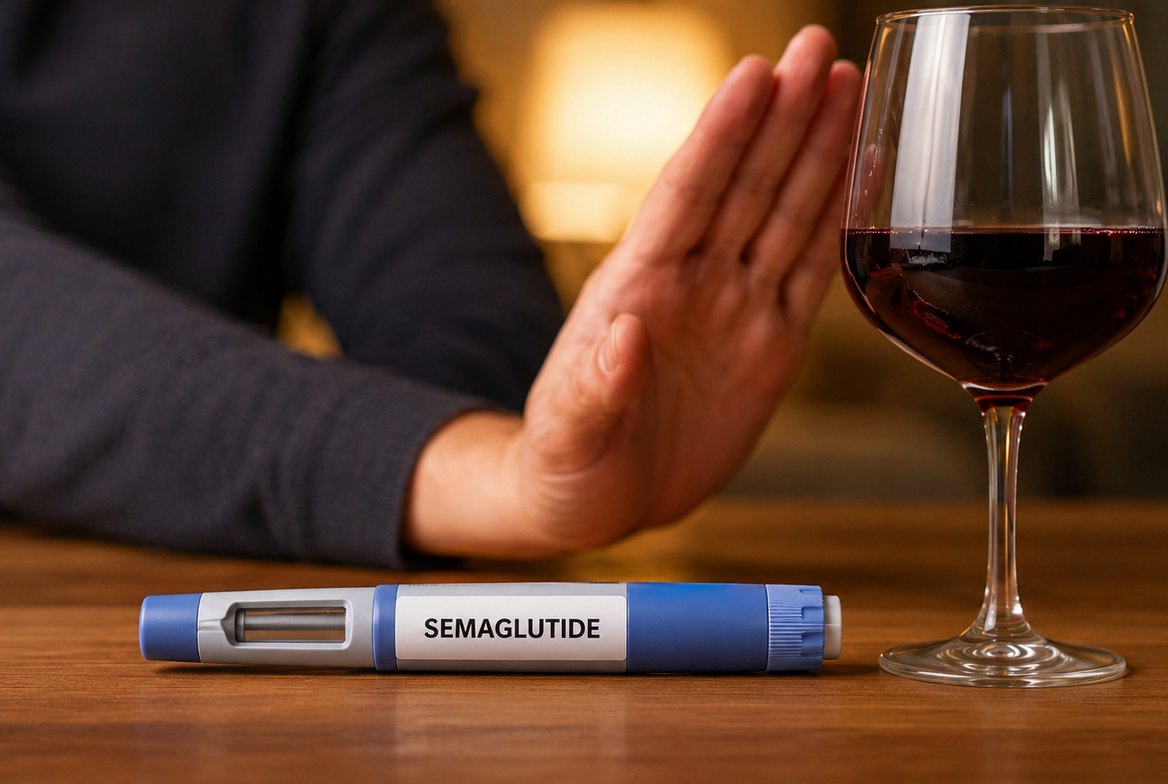
- The anecdotes were real, and now there’s a trial. A 2025 randomized controlled trial (RCT — the gold-standard study design with a placebo comparison) of low-dose semaglutide in adults with alcohol use disorder (AUD) reduced the amount consumed in a lab session, cut drinks per drinking day and weekly craving, and predicted less heavy drinking over time.1
- The mechanism is plausible. GLP-1 (glucagon-like peptide-1) receptors sit in brain reward hubs — the ventral tegmental area (VTA) and nucleus accumbens — where activation appears to blunt alcohol’s dopamine payoff.5
- Animals and real-world data agree. Semaglutide cuts drinking in rodents,37 and a cohort of ~84,000 people linked semaglutide to a 50–56% lower risk of new or recurrent AUD versus other weight drugs.4
- The limits are real. Trials are small and short, effect sizes are modest, an earlier exenatide RCT missed its main endpoint, and cohort data can’t prove cause.26
- This is off-label. No GLP-1 drug is approved for alcohol, AUD care belongs with a clinician, and this piece is not a recommendation to use one for drinking.6
- The anecdote that wouldn’t go away
- The mechanism: GLP-1 in the reward system
- What the animal studies showed first
- The 2025 RCT: the trial that mattered
- The real-world and cohort signals
- Semaglutide vs tirzepatide, and who this is about
- Safety: alcohol, hypoglycemia, muscle
- The honest limits
- What this article is not saying
- References
The anecdote that wouldn’t go away
Most drug stories start in a lab and end, if they’re lucky, as an anecdote. This one ran backwards. Long before any alcohol trial existed, people taking GLP-1 receptor agonists — the class that includes semaglutide (sold as Ozempic for diabetes and Wegovy for weight) and tirzepatide (Mounjaro and Zepbound) — began reporting an effect nobody had prescribed them: they wanted to drink less. Not a heroic act of willpower, they said, but an absence. The craving simply lost its voice.
A single anecdote is worthless; a pattern this consistent, across this many people, is a hypothesis. And it landed on a receptor system scientists already knew touched more than blood sugar. GLP-1 is a gut hormone released after eating that tells the brain, in effect, enough. The obvious job is appetite. The interesting question, once the drinking reports piled up, was whether that same “enough” signal reached the circuits that govern not just hunger but wanting in general — the reward machinery that alcohol, nicotine, and other rewards all hijack. This is the tight, alcohol-specific version of a bigger story; for how GLP-1 drugs intersect with addiction across substances and behaviors, our companion piece on GLP-1 drugs and the addicted brain is the fuller addiction picture.
The mechanism: GLP-1 in the reward system
Here is why researchers took the anecdote seriously instead of dismissing it. GLP-1 receptors are not confined to the pancreas and gut. They are expressed in the brain, and crucially in the mesolimbic reward pathway — the dopamine circuit that assigns value to rewarding experiences. That includes the ventral tegmental area (VTA), where reward-signaling dopamine neurons originate, and the nucleus accumbens (NAc), the downstream hub where dopamine release translates into the felt sense of wanting and reward. Alcohol produces much of its pull by driving dopamine into the nucleus accumbens. If GLP-1 signaling can turn down that release, it can, in principle, turn down alcohol’s payoff.5
That is not just theory drawn on a whiteboard. In a set of precise rodent experiments, infusing a GLP-1 receptor agonist directly into the nucleus accumbens shell blocked alcohol’s locomotor stimulation, erased the memory of alcohol reward in a place-preference test, and reduced how much alcohol the animals drank — and heavy-drinking rats showed elevated GLP-1 receptor expression in that region, as if the system were already straining to compensate.5 A second study went further, showing fluorescently labeled semaglutide physically reaching the nucleus accumbens in drinking rats and blunting the dopamine surge alcohol normally causes there.7 The location of the receptors, the direction of the effect, and the behavior all line up.
Alcohol works by shouting reward into the nucleus accumbens. GLP-1 signaling appears to turn the volume down — not by making you unable to drink, but by making you want to less.
We grade the mechanism MODERATE rather than STRONG for an honest reason. The receptor mapping is solid, the rodent causal experiments are elegant, and the story is biologically coherent. But animal reward models are an imperfect mirror of a human sitting in a bar, the exact molecular chain (dopamine, GABA, gut-brain vagal signaling all seem involved) is still being untangled,3 and a plausible mechanism is a reason to run the trial, not a substitute for it. The mechanism explains why the anecdote might be real. It cannot tell you how much it helps a person.
What the animal studies showed first
Before any human alcohol trial reported out, the animal literature had already built a strikingly consistent case. In one key study, semaglutide dose-dependently reduced binge-like drinking in mice and cut both binge-like and dependence-induced drinking in rats, while altering GABA neurotransmission in brain regions tied to compulsive intake.3 A separate group found that even low doses of semaglutide reduced alcohol intake and blocked relapse-like drinking in male and female rats, tracing the effect to the nucleus accumbens and the dopamine system.7 The effect wasn’t a fluke of one lab, one dose, or one species.
There is an important caveat baked into these results, and honest reporting requires naming it: GLP-1 drugs suppress intake of other rewarding substances too, including sweet and caloric solutions.3 That raises a live question about specificity — is the drug selectively dampening alcohol reward, or globally dialing down consumption and reward-seeking? For a person, the practical outcome (drinking less) may be the same either way. But it matters for understanding the mechanism, and it’s a reason not to over-romanticize the “anti-craving” framing. What the animal work earned was the right to test the idea in people. That’s where it gets serious.
The 2025 RCT: the trial that mattered
Anecdotes and animals set the stage; a randomized controlled trial is what separates a signal from a story. In 2025, Hendershot and colleagues published the first RCT designed specifically to test a GLP-1 drug against alcohol in humans, in JAMA Psychiatry.1
It was a phase 2, double-blind, placebo-controlled trial: 48 adults with alcohol use disorder (AUD) — the clinical diagnosis for problem drinking — randomized to low-dose semaglutide (titrated up to 1.0 mg weekly) or placebo over nine weeks. Deliberately, these were non-treatment-seeking participants and the doses were low, which makes the design a clean test of the drug’s pharmacology rather than of a motivated quit attempt. The centerpiece was a controlled laboratory self-administration session — a standardized setting where participants can drink and researchers measure exactly how much.
The results moved in the hypothesized direction. Semaglutide reduced the amount of alcohol consumed in the post-treatment lab session, with medium-to-large effect sizes for grams of alcohol and for peak breath alcohol concentration. In everyday drinking, the drug did not change the average number of drinks per day or the number of drinking days — but it significantly reduced drinks per drinking day (that is, when people drank, they drank less) and weekly alcohol craving, and it predicted greater reductions in heavy drinking over time relative to placebo. A subgroup who smoked also cut cigarettes per day.1 The craving finding is the one that most directly matches the viral anecdote: the wanting went down.
This is real, prospective, randomized evidence — the thing the field had been missing. But note carefully what it is and isn’t. It is one trial of 48 people over nine weeks. It moved several outcomes but not all of them. That is precisely why we grade this claim EMERGING and not higher: a single small, short, positive phase-2 trial is a strong reason to run the large ones, not proof that the drug is a treatment. The authors say as much — their own conclusion is that the findings “justify larger clinical trials.”1
2025 RCT
9-week phase 2 trial
per drinking day
semaglutide vs placebo
in cohort data
~84k people, observational
The 2025 trial also didn’t arrive out of nowhere. An earlier RCT by Klausen and colleagues (2022) tested the older GLP-1 drug exenatide in 127 treatment-seeking AUD patients over 26 weeks. Its headline result was, honestly, a miss: exenatide did not significantly reduce heavy drinking days overall.2 But it did something telling — it significantly reduced brain cue-reactivity to alcohol on functional MRI in reward regions (ventral striatum), lowered dopamine-transporter availability, and, in a pre-specified subgroup of participants with obesity, did reduce heavy drinking.2 Read together, the two trials sketch a coherent arc: an early study that hit the brain but missed the behavioral endpoint, followed by a newer, more potent agent that moved the behavior. That progression is why the field is cautiously optimistic rather than either dismissive or breathless.
The real-world and cohort signals
The third leg of the evidence stool is observational: what happens to alcohol outcomes when large populations take these drugs for other reasons? Here the numbers look dramatic, and the caveats are just as large.
In a retrospective cohort study of electronic health records covering roughly 84,000 patients with obesity, Wang and colleagues (2024) found that semaglutide, compared with other anti-obesity medications, was associated with a 50–56% lower risk of both the first onset and the recurrence of alcohol use disorder over a 12-month window — with the pattern holding across sex, age, and race, and replicating in a second population of nearly 600,000 patients with type 2 diabetes.4 A 2024 systematic review pulling together the RCTs and observational studies reached a measured version of the same conclusion: subgroup RCT data plus several observational studies suggest GLP-1 drugs may reduce alcohol consumption and alcohol-related healthcare events in some people — while explicitly cautioning that the high-quality evidence is still thin and the findings heterogeneous.6
We grade the real-world claim MODERATE, and the reason is baked into the word associated. Cohort studies cannot randomize; people prescribed semaglutide differ from people who aren’t in ways that are hard to fully measure (health engagement, socioeconomics, other prescriptions), and that residual confounding can inflate or manufacture an effect. A 56% risk reduction in a database is a compelling reason to run trials — it is not itself trial-grade proof. The honest reading is that three independent lines of evidence — mechanism, animals, and now both a positive RCT and large cohorts — are pointing the same way, which is more than most promising ideas ever manage, and still short of settled.
Semaglutide vs tirzepatide, and who this is about
Almost all the human alcohol data is on semaglutide and the older exenatide. That’s worth stating plainly because the loudest anecdotes now include tirzepatide (Mounjaro, Zepbound), a dual GIP/GLP-1 agonist that is more potent for weight loss. It is biologically reasonable that tirzepatide would share the alcohol effect — it hits the same GLP-1 receptor among others — but the dedicated alcohol trials to date are semaglutide-and-exenatide, not tirzepatide. Extending the finding to tirzepatide is a plausible inference, not a measured result. For the drug-level background, see our reference entries on semaglutide and tirzepatide.
It’s also worth being clear about who the interesting effect is for. There are two overlapping groups in the conversation. The first is people with diagnosed AUD who might one day be prescribed a GLP-1 drug specifically to help — the population the trials study, and where any future approval would live. The second is the far larger group already on these drugs for weight or diabetes who notice their drinking drift down as a side effect. The second group is real and is arguably where most of the anecdotal wave comes from, but it is not the same as demonstrating the drug is a treatment. A pleasant side effect in weight-loss patients and a licensed indication for AUD are separated by exactly the trials that haven’t been finished yet.
Safety: alcohol, hypoglycemia, muscle
If anyone is going to combine heavy drinking with a GLP-1 drug — whether by design or because they’re already on one — a few safety points deserve honest weight, and none of this is a protocol; it’s context for a conversation with a clinician.
Gastrointestinal effects and drinking. The dominant side effects of GLP-1 drugs are nausea, vomiting, and slowed gastric emptying. Alcohol is itself a gastric irritant, and layering heavy drinking on top of GLP-1–induced nausea and delayed emptying is an unpleasant, dehydrating combination. In the trials, adverse events were mainly gastrointestinal and generally mild-to-moderate,2 but that’s in supervised settings at studied doses.
Hypoglycemia. Alcohol can lower blood sugar and blunt the body’s ability to recover from a low. That risk is amplified in anyone also taking glucose-lowering therapy — especially insulin or sulfonylureas alongside a GLP-1 drug. Heavy drinking plus glucose-lowering medication is a genuine hypoglycemia hazard, not a theoretical one.
Pancreatitis. Both heavy alcohol use and GLP-1 drugs carry their own associations with pancreatitis. The combined picture is not well characterized, which is itself a reason for caution rather than reassurance in someone drinking heavily.
The muscle-loss issue. GLP-1–driven weight loss costs lean mass, not just fat — and heavy alcohol use independently undermines muscle protein synthesis and nutrition. Someone drinking heavily while losing weight rapidly on a GLP-1 drug is stacking two catabolic pressures. We cover the lean-mass problem in depth in our piece on GLP-1 weight regain and lean mass, which is essential context here. The overall message is not “this is dangerous” in absolute terms — it’s that combining active heavy drinking with these drugs is exactly the scenario that needs medical supervision, not self-experimentation.
The temptation the anecdotes create is obvious: if a friend’s drinking melted away on Ozempic, why not try it for yours? That inverts good practice on two counts. First, alcohol use disorder is a medical condition with real treatments — behavioral therapy and approved medications like naltrexone and acamprosate — and swapping proven care for an off-label bet on a weight drug is a poor trade. Second, if you drink heavily, cutting down or stopping is not risk-free: alcohol withdrawal can cause seizures and, at the severe end, delirium tremens, which is why it should be medically supervised. The right move isn’t “GLP-1 for drinking: yes or no?” on your own; it’s bringing this evidence to a clinician who can weigh your history, your other medications, and the treatments that already have approval behind them. For where these drugs succeed and fail in their actual lane, our read on GLP-1 non-responders is a useful reality check.
The honest limits
Set the enthusiasm against the ledger. The single biggest limitation is that the human evidence is small and short. The positive 2025 RCT enrolled 48 people for nine weeks;1 the earlier exenatide RCT was larger and longer but missed its primary endpoint, rescuing a signal mainly from brain imaging and an obesity subgroup.2 That is a promising but thin base — not the multi-thousand-patient, months-long outcome trials that anchor an approved indication. We grade the “small/short, uncertain effect size” claim MODERATE because the limitation itself is well documented across the RCTs and the systematic review.6
Three more honest caveats. First, effect sizes are modest where they’re positive: the drug reduced how much people drank when they drank and lowered craving, but in the 2025 trial it didn’t move the number of drinking days — a partial, not total, effect.1 Second, the strongest-looking numbers (the 50–56% risk reductions) come from observational data that can’t establish cause.4 Third, durability is unknown — nobody has shown whether the effect holds for years or fades, and whether drinking rebounds when the drug stops, the way weight so often does. Anyone framing this as equivalent to an approved AUD medication is running well ahead of the data.
What this article is not saying
This is not “GLP-1 drugs don’t affect drinking.” They plainly do something. The receptors sit in the right brain regions, rodents drink less, the real-world data lean hard in one direction, and the first proper RCT came back positive for craving and heavy drinking.15 Dismissing this signal would be as wrong as overselling it. Among the wave of “Ozempic cures everything” claims, this is one of the more mechanistically grounded and best-evidenced.
This is not “GLP-1 drugs are an approved, proven treatment for alcohol use disorder.” That is the HYPE claim, and it fails on the facts: no GLP-1 drug is approved for AUD, the trials are early and small, and the effect is partial.6 Nor is it true that “Ozempic reliably makes everyone stop drinking” — the effect is a reduction in some outcomes for some people, not an off-switch, and one of the two human RCTs missed its main endpoint entirely.2 The viral version of this story is louder than the evidence.
And this is not a treatment recommendation. Every figure here describes what published studies reported, not what you should take. These are prescription drugs approved for other conditions, used off-label for alcohol only inside research. Alcohol use disorder is serious, its established treatments work, and cutting down on heavy drinking can itself be medically dangerous without supervision. Whether a GLP-1 drug ever belongs in someone’s care for drinking is a decision for that person and a clinician who knows their full picture — not a takeaway from an article or a trend. The point of this piece is to tell you exactly what the science shows and precisely where it stops, so that conversation can be an honest one. For the wider view of how these drugs touch the addicted brain beyond alcohol, our GLP-1 and addiction piece is the companion to this one, and the full pharmaceuticals hub collects the same evidence-first treatment for the rest of the toolkit.
References
- Hendershot CS, Bremmer MP, Paladino MB, Kostantinis G, et al. Once-Weekly Semaglutide in Adults With Alcohol Use Disorder: A Randomized Clinical Trial. JAMA Psychiatry. 2025;82(4):395-405. DOI · PMID 39937469
- Klausen MK, Jensen ME, Møller M, Le Dous N, et al. Exenatide once weekly for alcohol use disorder investigated in a randomized, placebo-controlled clinical trial. JCI Insight. 2022;7(19):e159863. DOI · PMID 36066977
- Chuong V, Farokhnia M, Khom S, Pince CL, et al. The glucagon-like peptide-1 (GLP-1) analogue semaglutide reduces alcohol drinking and modulates central GABA neurotransmission. JCI Insight. 2023;8(12):e170671. DOI · PMID 37192005
- Wang W, Volkow ND, Berger NA, Davis PB, et al. Associations of semaglutide with incidence and recurrence of alcohol use disorder in real-world population. Nat Commun. 2024;15(1):4548. DOI · PMID 38806481
- Vallöf D, Kalafateli AL, Jerlhag E. Brain region specific glucagon-like peptide-1 receptors regulate alcohol-induced behaviors in rodents. Psychoneuroendocrinology. 2019;103:284-295. DOI · PMID 30771711
- Subhani M, Dhanda A, King JA, Warren FC, et al. Association between glucagon-like peptide-1 receptor agonists use and change in alcohol consumption: a systematic review. eClinicalMedicine. 2024;78:102920. DOI · PMID 39764544
- Aranäs C, Edvardsson CE, Shevchouk OT, Zhang Q, et al. Semaglutide reduces alcohol intake and relapse-like drinking in male and female rats. eBioMedicine. 2023;93:104642. DOI · PMID 37295046