FDA just cleared the first human partial epigenetic reprogramming trial.
Life Biosciences' ER-100 — an adeno-associated virus delivering three Yamanaka factors under a doxycycline switch — became the first partial cellular reprogramming therapy authorized for human testing. Initial cohort: about a dozen patients with glaucoma and NAION. What the mechanism actually is, why the eye, the logic of the kill-switch, and how to read the readout when it comes.
What just happened
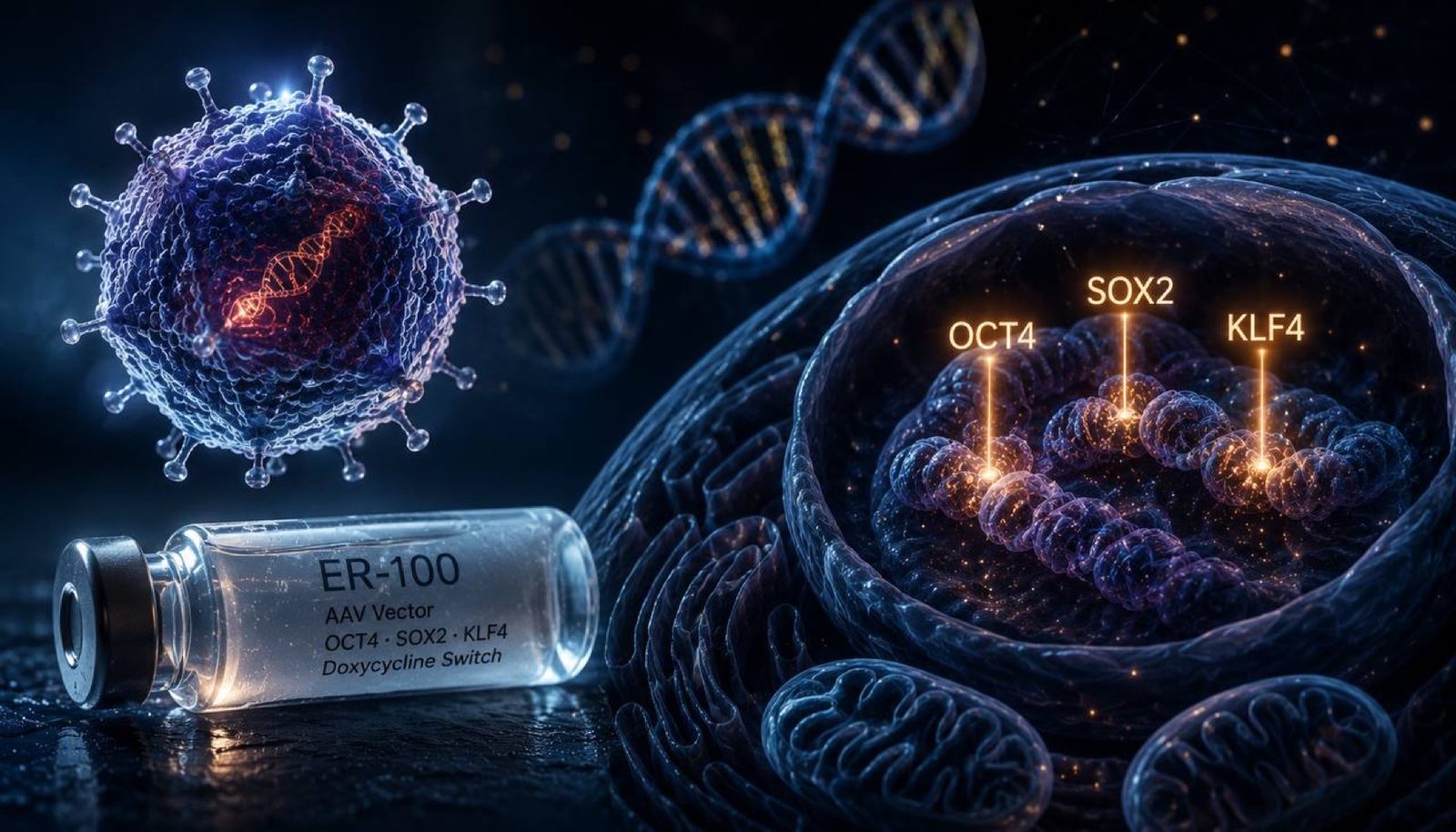
On January 28, 2026, Life Biosciences — a Boston-based aging-biology company co-founded by David Sinclair — announced that the U.S. Food and Drug Administration had cleared its Investigational New Drug (IND) application for ER-100 [Life Bio IND 2026]. ER-100 is an adeno-associated virus (AAV) gene therapy that delivers three of the four Yamanaka factors — OCT4, SOX2, and KLF4 — into retinal ganglion cells via a single intravitreal injection. Expression of the payload is gated by a doxycycline-responsive promoter, meaning the reprogramming program is silent at baseline and only activated when the patient takes oral doxycycline.
The cleared protocol is a Phase 1 first-in-human study registered as NCT07290244 [NCT07290244]. It will enroll an initial cohort of roughly twelve patients across two indications: open-angle glaucoma and non-arteritic anterior ischemic optic neuropathy (NAION). Primary endpoints are safety, tolerability, immune response to the AAV capsid and to the transgene, and standardized visual function assessments. The trial began dosing in the first quarter of 2026.
Two things are simultaneously true and worth saying out loud. First: this is the first time a partial cellular reprogramming therapy — the technical descendant of the work that won Shinya Yamanaka a share of the 2012 Nobel Prize [Takahashi 2006] — has been authorized for human testing. The category itself is making its clinical debut. Second: ER-100 is being tested as a vision therapy in two specific optic neuropathies. It is not being tested as an anti-aging drug. The framing inside the trial and the framing inside the wider longevity conversation should not be confused for each other.
Partial reprogramming, briefly explained
In 2006, Kazutoshi Takahashi and Shinya Yamanaka demonstrated that forced expression of four transcription factors — OCT4, SOX2, KLF4, and c-MYC, collectively the Yamanaka factors or OSKM — could revert differentiated mouse fibroblasts to a pluripotent state, producing what are now called induced pluripotent stem cells, or iPSCs [Takahashi 2006]. The cells lost their adult identity entirely. They could be differentiated back into any tissue. They also formed teratomas if implanted in vivo.
Partial reprogramming is the controlled, partial version of that same process. Instead of running the OSKM (or OSK) factors to completion and producing a pluripotent stem cell, the factors are expressed transiently — long enough to erase age-related epigenetic marks, short enough that the cell does not lose its differentiated identity. The 2016 Ocampo et al. paper in Cell, from Juan Carlos Izpisúa Belmonte's lab, was the first compelling demonstration in a whole mammal: cyclic in-vivo induction of OSKM (two days on, five days off) in a progeria mouse model extended median lifespan by 33% and partially reversed multiple aging hallmarks without producing teratomas [Ocampo 2016].
The next inflection point was the 2020 Lu et al. paper in Nature, also from David Sinclair's group at Harvard [Lu 2020]. The Lu paper made two decisions that mattered for everything that came after. It dropped c-MYC — the most oncogenic of the four Yamanaka factors — and ran only OCT4, SOX2, and KLF4 (OSK). And it delivered the cassette to the retina of mice via an AAV vector under a tetracycline-responsive promoter.
The readout was substantial. OSK expression in retinal ganglion cells restored youthful DNA methylation patterns, promoted axon regeneration after optic nerve crush injury, and recovered visual function in both aged mice and a mouse model of glaucoma. The epigenetic clock — the methylation-based estimator of biological age — was reset in the treated cells. The transcriptome moved toward a younger state. Cell identity was preserved.
The Browder et al. 2022 paper in Nature Aging extended the finding from a disease model to physiological aging, showing that long-term partial reprogramming altered age-associated molecular changes across multiple tissues in normally aging mice [Browder 2022]. The dose-response was tissue-specific. The duration mattered. The signal was real and reproducible across independent labs — and that combination is rare enough in the longevity literature to be worth noting.
The mouse story has been remarkably consistent for six years. The human story starts now, in twelve people, in one tissue.
Why glaucoma and NAION as the first indication
The choice of indication is not incidental. It is the single most defensible feature of the trial design. There are at least four reasons the eye is where partial reprogramming should debut in humans, and they stack rather than substitute.
The eye is immune-privileged. The blood-retinal barrier limits systemic exposure to anything injected into the vitreous. An AAV dose that would provoke a robust antibody response if administered intravenously can sit in the eye with a much smaller systemic immune footprint. That matters for any AAV-based therapy, because pre-existing or treatment-induced anti-AAV immunity is the principal headache of the entire AAV gene-therapy field.
The dose is small and the delivery is local. Intravitreal injection delivers the AAV payload directly to the target tissue at a fraction of the dose that systemic delivery would require. Lower systemic exposure means lower systemic risk, more predictable pharmacokinetics, and an adverse-event profile that ophthalmologists are already comfortable monitoring — the intravitreal route is the standard delivery method for anti-VEGF agents in age-related macular degeneration, and the safety framework is well established [NAION review].
The teratoma risk is meaningfully reduced. Manuel Serrano's lab showed in 2013 that uncontrolled in-vivo expression of the full four-factor OSKM cassette produces teratomas across multiple organs in mice [Abad 2013]. Dropping c-MYC reduces oncogenic potential. Running only three factors reduces it further. Localizing expression to a non-proliferating cell population — retinal ganglion cells in the adult eye divide rarely if at all — reduces it further still. Time-limiting expression via the doxycycline switch reduces it again. Each of those decisions is a defense in depth, and the eye permits all four simultaneously.
Glaucoma and NAION are conditions with a real unmet need. Glaucoma is the leading cause of irreversible blindness worldwide. Existing therapies lower intraocular pressure and slow disease progression but do not restore lost retinal ganglion cells. NAION — non-arteritic anterior ischemic optic neuropathy — affects approximately 2.3 to 10.2 per 100,000 adults over 50 in the U.S. annually, has no FDA-approved treatment, and leaves most patients with permanent vision loss [NAION review]. That clinical landscape matters regulatorily: a Phase 1 safety trial in patients who already have irreversible disease is an easier ethical and statistical case than testing the same intervention in healthy adults to "slow aging."
Put another way: ER-100 is being tested where the biology is most favorable, the delivery is best understood, the safety architecture is most layered, and the patient population most clearly stands to benefit if the therapy works. The fact that the same molecular program is the longevity field's most credited proof-of-concept is a feature of the broader narrative, not of the protocol.
The doxycycline kill-switch
The transgene cassette in ER-100 is built around a tetracycline-responsive promoter — a "Tet-On" system. In Tet-On constructs, the OCT4-SOX2-KLF4 cassette is silent at baseline. When the patient takes oral doxycycline (a common, well-tolerated antibiotic in the tetracycline class), the drug binds a regulatory protein (reverse tetracycline-controlled transactivator, or rtTA) encoded by the same vector, and the rtTA-doxycycline complex activates the promoter. The cassette switches on. Reprogramming factors are expressed. When the patient stops taking doxycycline, the promoter switches back off within days [Das 2016 TetOn].
The clinical logic is straightforward. If the patient develops a worrying adverse event — uncontrolled proliferation, an autoimmune response, anything that looks like loss of cell identity — stopping doxycycline turns the program off. The cassette stays in the target cell, but it stops producing the reprogramming proteins. Expression is, in effect, on a dimmer switch with a clinical operator.
This is the architectural feature that distinguishes ER-100 from the more aggressive cellular reprogramming concepts that have been in the popular conversation for a decade. Earlier in-vivo reprogramming systems used constitutive (always-on) expression and produced teratomas in mice when run too long. Cyclic systems, beginning with Ocampo 2016, used on-off pulsing to limit cumulative exposure [Ocampo 2016]. ER-100 inherits that lineage and adds a patient-administered, clinician-controlled switch on top of the localized delivery. The cassette will only run for as long as the doxycycline arm of the protocol allows it to run.
The doxycycline switch turns off new expression of OSK proteins. It does not remove the AAV vector from the cell — AAV episomes can persist for years in non-dividing tissue. If the off-state of the promoter is leaky, low-level expression could continue. The switch is a safety feature, not a guarantee. It is one of the cleanest such features in any gene-therapy construct currently in the clinic, but it is not a guarantee.
What a positive readout would mean
The Phase 1 trial is powered for safety, not for efficacy. The primary endpoints are adverse events, ocular inflammation, anti-AAV antibody titers, anti-transgene immune responses, and a standardized battery of visual function tests. Twelve patients is not enough to declare an efficacy result. The most a Phase 1 readout can deliver is the absence of unexpected toxicity, plus a suggestive signal on the visual endpoints that justifies a larger Phase 2.
If the data lands well — meaning no serious adverse events attributable to the construct, no concerning immune activation, and an early signal of visual function improvement in even a subset of treated eyes — three downstream consequences become more likely.
The category becomes investable. Until ER-100, every partial-reprogramming startup operated under a single piece of regulatory uncertainty: would the FDA permit any version of this in humans? The IND clearance answered that question for a specific construct in a specific tissue. A clean Phase 1 readout would extend the answer to the category. That changes the funding environment for adjacent programs — Turn Bio, Altos Labs, and the smaller players working on tissue-restricted reprogramming all benefit from a precedent.
Other immune-privileged, non-dividing tissues become the obvious next targets. Cochlear hair cells for sensorineural hearing loss. Cardiac muscle for post-MI recovery. Spinal cord neurons after injury. The pattern that worked for the eye — immune-privileged site, local delivery, non-dividing target, time-limited expression — is the pattern that would be tried next.
The systemic-aging conversation gets one rung more credible. The framing that has dominated the field for a decade — that partial reprogramming might one day be a generalizable rejuvenation strategy across tissues — gets a clinical data point rather than a mouse paper to anchor it. The data point is not proof. It would not justify off-label systemic use of any related construct (there is no related construct that could be administered off-label, anyway). But it would be the first time the human evidence base for the whole rejuvenation hypothesis was not zero.
For context on how thin the human longevity evidence base currently is: we have written separately on what the human rapamycin trials actually show, and the answer is "less than the conversation reflects." A clean first-in-human reprogramming readout, even in a narrow indication, would change the shape of that conversation in a way that few plausible near-term results otherwise could.
Reasons to stay measured
The honest version of this article requires the next section to be longer than the optimistic one, because the most likely failure modes outnumber the most likely successes. Five reasons to keep expectations in check:
- The mouse-to-human translation gap in optic-nerve biology. The Lu 2020 paper restored vision in mice. Mouse retinal ganglion cells regenerate axons under conditions where human cells largely do not. The same molecular intervention may produce smaller — or different — effects in the human eye than in the mouse eye, and we will only know which after the data is in [Lu 2020].
- Pre-existing AAV immunity. A meaningful fraction of adults — estimates range widely depending on serotype but easily 20–60% — have neutralizing antibodies against common AAV capsids from prior environmental exposure. Patients with pre-existing immunity may not be eligible, may have blunted transduction efficiency, or may have inflammatory responses that limit dosing. This is a known problem across the AAV gene therapy field, not a problem specific to ER-100, and it constrains how many patients can be treated at any given dose.
- Promoter leakiness. Tet-On systems are tight in well-controlled in-vitro settings. They are leakier in vivo. Some basal expression of OSK in the absence of doxycycline is plausible. Whether that low-level expression is clinically meaningful — for efficacy or for safety — is a question the first cohort will begin to answer [Das 2016 TetOn].
- Off-target effects of OSK expression. OCT4 and SOX2 are master pluripotency transcription factors. Even transient expression in differentiated cells can affect gene programs the investigators are not specifically looking at. The retinal ganglion cell is the intended target, but AAV biodistribution in the eye is not perfectly restricted. Effects on the retinal pigment epithelium, on photoreceptors, or on inner retinal interneurons need to be monitored.
- The category's most dangerous moment is right now. A first-in-human IND clearance is the point in a therapeutic category's life cycle where investor interest is highest, retail interest is highest, and clinical evidence is lowest. The gap between what has been demonstrated (an animal model and a twelve-patient safety trial in progress) and what gets implied in the consumer conversation (general rejuvenation therapy approaching the clinic) is wider than it will ever be again. The appropriate response to that asymmetry is patience, not capital deployment. A clean Phase 1 in 2026–2027 still leaves Phase 2, Phase 3, and a multi-year approval process between any healthy adult and access to anything related.
ER-100 is not an anti-aging drug. It is a Phase 1 gene therapy in two specific optic neuropathies. The mechanism is shared with the aging-reversal hypothesis, but a positive result in the eye is not a positive result for systemic rejuvenation, and no regulatory body — including the FDA — will treat it as one. Any marketing that describes ER-100 or any related construct as a "longevity therapy" is running well ahead of what has actually been cleared.
A note on what we are not telling you. We are not telling you to seek out any cellular reprogramming protocol, anywhere, from any clinic. There are no validated human reprogramming protocols outside the registered trials. There are no compounded versions of ER-100, and there cannot be — AAV gene therapy is not a small molecule that a compounding pharmacy can replicate. If a clinic offers you "epigenetic reprogramming" today, what they are selling is not what you are reading about here. Wellness Radar is informational, not medical advice; the only reasonable consumer action on this story for the next 24 months is to read the readouts.
Bottom line
Six years ago, partial cellular reprogramming was a mouse paper. In 2020, it became a mouse paper that recovered vision. In 2022, it became a mouse paper that altered physiological aging signatures. In January 2026, it became a cleared IND in twelve patients. That trajectory — animal proof of concept to first-in-human, across one very specific indication, with an unusually layered safety architecture — is exactly the trajectory the rejuvenation field was supposed to take if the underlying biology was real and the regulators were doing their job.
It is also the trajectory at which roughly half of all promising early-stage therapies fail. Phase 1 trials read out negative or ambiguous more often than they read out positive. AAV gene therapy in particular has a track record full of dose-limiting toxicities, immune events, and dose ranges that did not translate from mice the way the preclinical work suggested.
The most useful thing a careful reader can do for the next 24 months is to track the actual data. The readout on NCT07290244, when it comes, will be specific. Did the treated eyes show any change in visual function relative to untreated fellow eyes? Did the immune response stay within an acceptable range? Did the doxycycline switch behave as designed? Were there any serious adverse events? The answers to those questions — not the press cycle around them — will determine whether the longevity field's 2026 had a real inflection point or another false start.
For our running view of the longevity intervention landscape — what currently holds up in human data and what does not — see the longevity hub. For our running view of the broader therapeutic peptide pipeline, see the peptides worth knowing in 2026. For the reference profile on rapamycin, which remains the best-replicated mouse longevity intervention and the most studied human one, see the rapamycin reference.
We think this is the most interesting longevity story of 2026 so far, and we think the appropriate response is patience, not excitement. Both at the same time. Twelve patients is a beginning. The rest of the field — including the consumer conversation — should let those twelve patients finish their trial before deciding what the result means.
References
- Life Biosciences. Life Biosciences Announces FDA Clearance of IND Application for ER-100 in Optic Neuropathies. Press release, January 28, 2026. lifebiosciences.com
- ClinicalTrials.gov. Evaluating ER-100 for Safety in People With Glaucoma or Non-Arteritic Anterior Ischemic Optic Neuropathy. NCT07290244. clinicaltrials.gov/study/NCT07290244
- Takahashi K, Yamanaka S. Induction of pluripotent stem cells from mouse embryonic and adult fibroblast cultures by defined factors. Cell. 2006;126(4):663-676. doi:10.1016/j.cell.2006.07.024
- Lu Y, Brommer B, Tian X, et al. Reprogramming to recover youthful epigenetic information and restore vision. Nature. 2020;588:124-129. doi:10.1038/s41586-020-2975-4
- Ocampo A, Reddy P, Martinez-Redondo P, et al. In Vivo Amelioration of Age-Associated Hallmarks by Partial Reprogramming. Cell. 2016;167(7):1719-1733.e12. doi:10.1016/j.cell.2016.11.052
- Browder KC, Reddy P, Yamamoto M, et al. In vivo partial reprogramming alters age-associated molecular changes during physiological aging in mice. Nature Aging. 2022;2:243-253. doi:10.1038/s43587-022-00183-2
- Abad M, Mosteiro L, Pantoja C, et al. Reprogramming in vivo produces teratomas and iPS cells with totipotency features. Nature. 2013;502:340-345. doi:10.1038/nature12586
- Das AT, Tenenbaum L, Berkhout B. Tet-On Systems For Doxycycline-inducible Gene Expression. Curr Gene Ther. 2016;16(3):156-167.
- Hayreh SS. Ischemic optic neuropathy. Prog Retin Eye Res. 2009;28(1):34-62. (Also: Berry S et al., NAION clinical review, EyeWiki / American Academy of Ophthalmology, 2024 update.)
- Massey Eye and Ear / Harvard Medical School. Scientists Reverse Age-Related Vision Loss, Eye Damage from Glaucoma in Mice. Press release, December 2020. masseyeandear.org
- Simpson EM, Korecki AJ, Fornes O, et al. Reprogramming to help the old see like the young. Science Translational Medicine. 2021;13(581):eabf7738. doi:10.1126/scitranslmed.abf7738