D-ribose for energy and fatigue: the ATP-refill theory is elegant — so why do the athletic trials keep coming back empty?
Of all the “cellular energy” supplements, D-ribose has one of the most respectable-sounding stories. It is not a stimulant and not a vitamin; it is a small 5-carbon sugar that your body actually uses to build ATP — adenosine triphosphate, the molecule every cell spends to do work. The pitch writes itself: your tissues run low on ATP when they’re stressed, rebuilding it is slow, and D-ribose is the missing building block that lets them refill faster. It sounds like plugging a battery straight into the wall. And in the right, narrow context — a heart muscle recovering from oxygen starvation, certain deep-fatigue states — there is real biochemistry behind that story. The problem is that the supplement is sold mainly to healthy people chasing more gym energy and faster recovery, and that is precisely the population where the controlled trials keep coming back flat. This is the honest, evidence-graded read: what D-ribose is, why the ATP theory is genuinely coherent, what the human data show — population by population — on athletic performance, chronic fatigue and fibromyalgia, and heart failure, plus dosing, safety, and where the marketing outruns the science.
How this article was built: Primary sources: the Teitelbaum et al. 2006 D-ribose pilot study in chronic fatigue syndrome and fibromyalgia in the Journal of Alternative and Complementary Medicine; the Teitelbaum et al. 2012 open-label multicenter follow-up in The Open Pain Journal; the Omran et al. 2003 randomized crossover trial of D-ribose in congestive heart failure in the European Journal of Heart Failure; the Kreider et al. 2003 anaerobic-capacity trial in the International Journal of Sport Nutrition and Exercise Metabolism; the Berardi & Ziegenfuss 2003 repeated-sprint trial in the Journal of Strength and Conditioning Research; and the Seifert et al. 2017 fitness-level performance-and-recovery trial in the Journal of the International Society of Sports Nutrition — all retrieved and verified through PubMed and the Consensus research database.
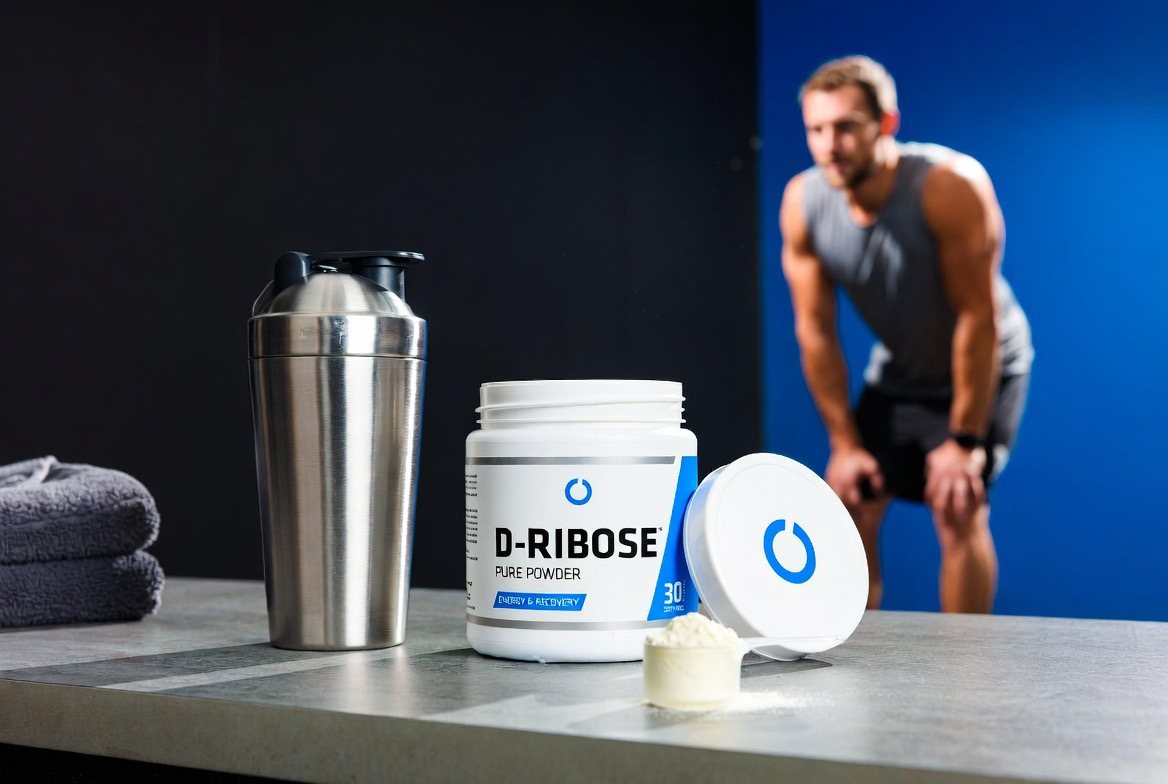
- The theory is legitimate. D-ribose is a real building block of ATP, and in tissue that’s been drained of adenine nucleotides, remaking ribose is the slow, rate-limiting step — so supplying it can genuinely speed the refill. That mechanism is sound; the question is who is actually in that depleted state.3
- For athletes, the evidence is weak to negative. Well-controlled trials of anaerobic capacity, repeated sprints, and resistance training in healthy, trained people mostly show no meaningful benefit — a couple of small, inconsistent signals at most. A well-fed, well-trained body is not ribose-starved.45
- The niche clinical uses have more rationale — and thinner evidence. Small, mostly open-label work in chronic fatigue syndrome and fibromyalgia reported symptom improvement, and small trials in heart failure and myocardial ischemia found modest gains. Promising, low-quality, not proof.13
- Dose is high, safety is decent, but it’s a sugar. Typical doses are 5 g two-to-three times daily. It’s generally well tolerated, but large single doses can cause GI upset and it can lower blood sugar — a real consideration in diabetes.12
What D-ribose actually is
Start with the molecule, because the whole argument turns on it. D-ribose is a pentose — a sugar with five carbon atoms, one fewer than the glucose your body runs on. It is not exotic or synthetic; it is a natural, essential sugar present in every living cell, and it forms part of the structural backbone of some of biology’s most important molecules. Ribose is the “R” in RNA (ribonucleic acid). It sits inside ATP, the universal energy currency. It is a component of the electron carriers — the NAD (nicotinamide adenine dinucleotide) and FAD that shuttle energy through metabolism. Wherever a cell handles energy or genetic information, ribose is somewhere in the scaffolding.
Your body makes its own ribose, primarily through a branch of glucose metabolism called the pentose phosphate pathway (a side-route off the main sugar-burning highway). Under normal conditions that supply is adequate. The interesting wrinkle — and the seed of the entire supplement rationale — is that some tissues, notably heart and skeletal muscle, run this pathway slowly. They are optimized to burn glucose for immediate energy, not to divert it into making fresh ribose. That distinction seems academic until a tissue is stressed hard enough to lose part of its stockpile of adenine nucleotides — the ATP, ADP, and AMP that make up its energy pool. When that happens, rebuilding the pool requires new ribose, and in heart and muscle that manufacturing step is the bottleneck.
That is the honest one-paragraph version of D-ribose: a real, essential sugar that the body normally makes enough of, sold as a supplement on the premise that in certain stressed tissues the body can’t make it fast enough. Whether that premise applies to you is the question the rest of this article is about — and the answer depends enormously on who “you” are.
The theory: refilling the ATP pool
To evaluate D-ribose fairly you have to give the mechanism its due, because it is more coherent than most supplement stories. Here is the chain, step by step.
Cells power work by spending ATP, splitting off a phosphate to release energy and leaving ADP, which is normally recycled straight back to ATP. Under extreme demand or oxygen shortage — a sprinting muscle, a heart region choked of blood flow — recycling can’t keep pace, and some of the adenine nucleotides degrade further and wash out of the cell entirely. The energy pool doesn’t just get temporarily emptied; it gets physically smaller. Refilling it means synthesizing new nucleotides from scratch (the de novo pathway) or reclaiming the leftover fragments (the salvage pathway). Both of those routes require activated ribose — specifically a molecule called PRPP — and making that ribose in heart and muscle is the slow, rate-limiting step.3
Supplemental D-ribose is meant to short-circuit exactly that bottleneck. Feed the tissue ribose directly and it can skip the sluggish manufacturing step, accelerating both de novo synthesis and salvage, and rebuild its shrunken ATP pool in a fraction of the time. In animal and isolated-tissue work, this is well demonstrated: give ribose to a heart recovering from ischemia and its nucleotide levels and function recover faster. This is why we grade the underlying mechanism MODERATE rather than dismissing it — the biochemistry is genuine and the depleted-tissue models are real.
The mechanism isn’t the weak link. The weak link is the assumption that a healthy, well-fed body is walking around with a depleted ATP pool waiting to be topped up. It usually isn’t.
And that is the pivot the marketing quietly steps over. Everything about the ATP-refill story depends on the tissue actually being depleted — on the energy pool having been physically shrunk by ischemia, extreme metabolic stress, or a pathological state. In a rested, fed, healthy person, the nucleotide pool is full and the body’s own ribose production is entirely adequate. There is no empty tank to fill. The theory is sound; its applicability is narrow. Keep that distinction in mind, because it explains the entire pattern of the human evidence: strongest rationale where tissue is genuinely energy-starved, weakest where it isn’t.
Athletic performance: where the case falls apart
This is the population D-ribose is mostly marketed to, and it is where the evidence is weakest. The logic sounds airtight — high-intensity exercise depletes muscle ATP, ribose rebuilds ATP, therefore ribose should improve performance and recovery — but the controlled human trials have largely refused to cooperate.
The anaerobic-capacity trials came back flat. Kreider and colleagues’ 2003 study in the International Journal of Sport Nutrition and Exercise Metabolism tested exactly the premise, in trained men, with a proper design: randomized, double-blind, placebo-controlled, comparing 10 g/day of D-ribose against a dextrose placebo across repeated 30-second Wingate sprints — a brutal, ATP-taxing test.4 The result was essentially nothing. Ribose did not improve peak power, average power, torque, fatigue index, or the metabolic markers, and the authors concluded plainly that oral ribose does not affect anaerobic exercise capacity in trained subjects. There was one tiny statistical wrinkle in total work output, but no coherent performance benefit.
The repeated-sprint work was inconsistent. Berardi and Ziegenfuss’s 2003 trial in the Journal of Strength and Conditioning Research used a placebo-controlled crossover design and repeated cycle sprints.5 They did see statistically significant bumps in mean and peak power — but only in one specific sprint, not reproduced across the full set of six. Their own conclusion is the honest read: ribose did not show consistent or substantial performance effects. A benefit that appears in sprint two but vanishes in sprints one, three, four, five, and six is the signature of noise, not a real ergogenic effect.
The most interesting result is also the most limiting one. Seifert and colleagues’ 2017 study in the Journal of the International Society of Sports Nutrition is the trial ribose advocates cite — and read carefully, it makes the skeptic’s case.6 Across multiple days of high-intensity interval cycling, 10 g/day of D-ribose helped maintain power output and lowered perceived exertion and a muscle-damage marker — but only in the lower-fitness subgroup. In the higher-VO2, better-trained participants, ribose did nothing measurable versus placebo. That is a strikingly consistent story: any benefit shows up in the less-conditioned, more metabolically stressed bodies and disappears in the well-trained ones. The fitter and better-fueled you are, the less an ATP building block has to offer — which is exactly what the depletion theory predicts, and exactly the opposite of who buys the supplement.
— and still mostly no effect
Kreider 2003, trained men
in the repeated-sprint trial
not reproducible — likely noise
well-trained subgroup
Seifert 2017 — fitter = no effect
Put the athletic literature together and the verdict is straightforward: in healthy, trained people, D-ribose is a WEAK ergogenic aid at best. The strongest, cleanest trials show no benefit; the positive signals are small, inconsistent, or confined to the least-fit participants. The reason is the one the mechanism section flagged — trained muscle recovers its ATP pool quickly on its own, and a well-fed athlete isn’t ribose-limited. There’s no empty tank for the supplement to fill.
The clinical niches: fatigue syndromes and the failing heart
Where the rationale gets more interesting is in populations whose tissues plausibly are energy-compromised. Here the theory has more purchase — but the honest framing is that the evidence, while directionally encouraging, is small, mostly uncontrolled, and a long way from proof.
Chronic fatigue syndrome and fibromyalgia. These conditions are associated in the literature with impaired cellular energy metabolism, which makes them a natural place to test an ATP-refill agent. Teitelbaum and colleagues’ 2006 pilot study in the Journal of Alternative and Complementary Medicine gave 41 patients D-ribose at 5 g three times daily and reported significant improvements across energy, sleep, mental clarity, pain, and well-being, with roughly two-thirds of patients improving and an average energy increase around 45%.1 A larger 2012 open-label multicenter follow-up in The Open Pain Journal, enrolling 257 patients across 53 clinics on the same 5 g three-times-daily regimen, reported similar gains.2 Those are meaningful-sounding numbers — and they come with a large, unavoidable caveat: both studies were open-label and uncontrolled. There was no blinded placebo group. In conditions defined by subjective, fluctuating symptoms, the placebo response is notoriously powerful, and an unblinded study cannot separate a real drug effect from expectation. So the correct grade is EMERGING: a coherent mechanism plus a genuine symptom signal, badly in need of a randomized, placebo-controlled trial before anyone calls it proven.
Congestive heart failure and myocardial ischemia. This is the context where the depletion theory is on firmest biological ground. The failing or ischemic heart is, in a real metabolic sense, energy-starved: its ATP pool is chronically reduced, and slow ribose synthesis genuinely limits how fast it can rebuild. Omran and colleagues’ 2003 trial in the European Journal of Heart Failure is the most-cited human data point — a small, prospective, double-blind, randomized crossover study in patients with chronic coronary artery disease and heart failure, comparing oral D-ribose against placebo.3 Ribose was associated with improved diastolic function (the heart’s ability to relax and fill between beats) and better quality-of-life scores, and the broader cardiac literature points in a consistent direction: modest gains in diastolic parameters and ischemic threshold. This is the strongest rationale in the whole D-ribose story. It is still, however, built on small, short trials with surrogate endpoints — not large outcome trials showing fewer hospitalizations or longer survival — which is why it too lands at EMERGING rather than anything firmer. It is a supervised, clinical use, not a self-prescribed one.
The single most useful reframe for D-ribose: the same supplement is genuinely different depending on whose tissue is receiving it. In an energy-starved heart or a deep-fatigue state, there may be a real ATP deficit for ribose to help refill — the rationale is sound even if the trials are still small. In a healthy, well-fed, well-trained body, there is no deficit, and the controlled data show it: no reliable performance or energy benefit. The mistake isn’t believing the mechanism; it’s assuming the mechanism applies to you when your ATP pool is already full. The Manual maps this population-by-population — where an energy substrate has a real target and where it’s pouring fuel into a full tank — with the evidence graded and the “cellular energy” marketing stripped out. See the Manual →
Dosing and how it’s taken
D-ribose dosing is unusual among supplements in that the amounts are large — grams, not milligrams — which follows from it being a sugar used as a metabolic substrate rather than a trace nutrient or a drug acting on a receptor.
The most common regimen across the clinical literature is 5 g taken two-to-three times daily, which is what the chronic-fatigue and heart-failure work used.13 Athletic trials typically used around 10 g/day, sometimes with a short front-loading “loading” phase.46 It comes as a fine white powder that dissolves readily in water or a beverage and tastes mildly sweet. Because the proposed benefit is faster ATP recovery, protocols generally split the dose through the day and, in exercise contexts, place a portion around training. There is no compelling evidence that any particular timing dramatically changes outcomes, largely because the outcomes themselves are modest to absent in healthy users. Splitting the dose has a practical purpose beyond kinetics, too: large single doses are the ones most likely to cause the side effects covered next.
Safety: it’s a sugar, and that matters
D-ribose has a generally reassuring tolerability record in the trials — it was described as well tolerated in the fatigue and cardiac studies — but “generally safe” is not “inert,” and two features deserve real attention.12
It can lower blood sugar. This is the most clinically important point and the one most often skipped. D-ribose can cause a transient drop in blood glucose (hypoglycemia), especially when taken in a large dose on an empty stomach. For most healthy people this is minor — a bit of lightheadedness at worst — but for anyone with diabetes, on glucose-lowering medication, or prone to hypoglycemia, it is a genuine interaction that warrants medical supervision. Taking it with food blunts the effect. The irony is worth noting: a supplement built on the fact that ribose is not an efficient fuel like glucose can still nudge your glucose downward.
GI upset at high doses. Like many sugars and sugar alcohols consumed in gram quantities, D-ribose can cause gastrointestinal side effects — nausea, diarrhea, loose stools, stomach discomfort — particularly with large single doses taken without food. This is dose-dependent and is the main reason protocols split the daily amount. It is uncomfortable rather than dangerous, and it usually resolves by lowering the per-dose amount or taking it with a meal.
Beyond those two, the notable gaps are the ordinary ones: there is limited long-term safety data at supplemental doses, and little information in pregnancy and breastfeeding, so those groups should default to avoidance. None of this makes D-ribose scary. It makes it a high-dose sugar with a specific blood-glucose caveat — worth respecting, easy to manage, and a reason not to hand it out casually to people managing diabetes or heart disease without a clinician in the loop.
The hype: “cellular energy” for everyone
Now the oversell. Because D-ribose is a real component of ATP, an entire genre of marketing sells it as a universal energy tonic: take it and your cells will make more energy, so you’ll feel less tired, train harder, recover faster, think more clearly. The molecule’s legitimate biochemistry gets stretched into a promise the human evidence does not support for the average buyer — the HYPE grade in this article’s Evidence Radar.
The flaw is the one we’ve traced throughout: “ribose is part of ATP” is true, but “therefore taking ribose gives a healthy person more energy” does not follow. A rested, well-fed body already has a full nucleotide pool and makes all the ribose it needs; adding more doesn’t manufacture surplus energy any more than dumping extra bricks on a finished wall makes the house taller. The controlled athletic trials are the cleanest test of the “more energy for everyone” claim, and they overwhelmingly show no reliable benefit in healthy people.45 The subjective “I feel more energetic” reports that fuel the marketing come largely from uncontrolled settings where expectation does the heavy lifting — which is exactly why the clinical fatigue studies, however encouraging, need placebo controls before anyone treats them as proof.
There is a subtler cost to the oversell, too. A generic “energy” supplement can become a way to paper over the actual drivers of fatigue — poor sleep, undereating, deconditioning, an untreated medical cause — with a scoop of sweet powder that, for most people, is doing nothing measurable. Sold honestly, D-ribose is a targeted metabolic substrate with a narrow, mostly clinical case. Sold as “cellular energy” for the whole population, it’s a full tank with a premium-priced funnel on top.
The verdict
D-ribose is a rare case where the mechanism deserves genuine respect and the marketing still earns a skeptical eyebrow. The biochemistry is real: it is an essential building block of ATP, and in tissue that has actually lost part of its nucleotide pool — an ischemic or failing heart, certain deep-fatigue states — the slow step of remaking ribose is a real bottleneck that supplementation can plausibly relieve.3 That is why the niche clinical uses carry more rationale than most supplement claims, and why the small heart-failure and chronic-fatigue signals are worth taking seriously as leads — while remembering they rest on small, mostly uncontrolled trials with surrogate endpoints, and belong in a supervised, clinical setting rather than a self-prescribed one.12
For the person most likely to buy it — a healthy athlete or a tired-but-well adult chasing more energy — the honest answer is that the case is weak. The cleanest, best-controlled trials show no reliable performance or recovery benefit, and the one study advocates lean on found its effect only in the least-fit participants, vanishing in the well-trained.46 The clean way to hold both truths at once: D-ribose refills an empty tank, and most people who buy it have a full one. If you have a diagnosed condition where cellular energy is genuinely compromised, it’s a reasonable thing to discuss with your clinician. If you’re healthy and just want more pep in the gym, the evidence says save your money, fix your sleep and your fueling, and be honest with yourself about which tank you’re actually trying to fill.
References
- Teitelbaum JE, Johnson C, St Cyr J. The use of D-ribose in chronic fatigue syndrome and fibromyalgia: a pilot study. J Altern Complement Med. 2006;12(9):857-862. DOI · PMID 17109576
- Teitelbaum J, Jandrain J, McGrew R. Treatment of Chronic Fatigue Syndrome and Fibromyalgia with D-Ribose — An Open-label, Multicenter Study. Open Pain J. 2012;5:32-37. DOI
- Omran H, Illien S, MacCarter D, St Cyr J, Lüderitz B. D-Ribose improves diastolic function and quality of life in congestive heart failure patients: a prospective feasibility study. Eur J Heart Fail. 2003;5(5):615-619. DOI · PMID 14607200
- Kreider RB, Melton C, Greenwood M, Rasmussen C, et al. Effects of oral D-ribose supplementation on anaerobic capacity and selected metabolic markers in healthy males. Int J Sport Nutr Exerc Metab. 2003;13(1):76-86. DOI · PMID 12660407
- Berardi JM, Ziegenfuss TN. Effects of ribose supplementation on repeated sprint performance in men. J Strength Cond Res. 2003;17(1):47-52. DOI · PMID 12580655
- Seifert JG, Brumet A, St Cyr JA. The influence of D-ribose ingestion and fitness level on performance and recovery. J Int Soc Sports Nutr. 2017;14:47. DOI · PMID 29296106