Butyrate and tributyrin: what the evidence really shows for your gut lining, IBS, and metabolic health
Butyrate (a short-chain fatty acid — SCFA — that your gut bacteria produce when they ferment dietary fiber) is one of the most important molecules in your colon, and the biology behind it is genuinely impressive. It is the main fuel for the cells lining your large intestine, it helps tighten the barrier that keeps gut contents out of your bloodstream, and it acts as a signal that calms inflammation. That endogenous story — butyrate made inside you by well-fed bacteria — is well supported. The problem starts the moment a supplement company bottles it. Swallowing butyrate, usually as sodium butyrate or its precursor tributyrin, is a completely different proposition from making your own, because oral butyrate is unstable and mostly absorbed or broken down long before it reaches the colon where it is supposed to work. The human trial evidence for the supplements is thin, small, and mixed: the most rigorous placebo-controlled trial in gut disease came back flat, controlled trials that put butyrate directly into the colon by enema have mostly failed, and the encouraging signals for IBS and metabolic markers lean on small, often combination-product studies. Here is the cited, evidence-graded read on where butyrate genuinely matters, why the endogenous case is strong and the pill case is weak, and how to tell the two apart.
How this article was built: Primary sources: the Hays et al. 2024 SCFA mechanism review in Gut Microbes; the Steinhart et al. 1996 butyrate-enema controlled trial in Alimentary Pharmacology & Therapeutics and the Jamka et al. 2021 systematic review of butyrate enemas in Complementary Medicine Research; the Pietrzak et al. 2022 placebo-controlled oral sodium-butyrate trial in pediatric IBD and the Gąsiorowska et al. 2022 microencapsulated-butyrate IBS trial protocol, both in the MDPI journals Nutrients and Journal of Clinical Medicine; the Duysburgh et al. 2025 tributyrin bioavailability study in Frontiers in Nutrition; and the Kalkan et al. 2025 butyrate narrative review in Nutrients — all retrieved and verified through PubMed and the Consensus research database.
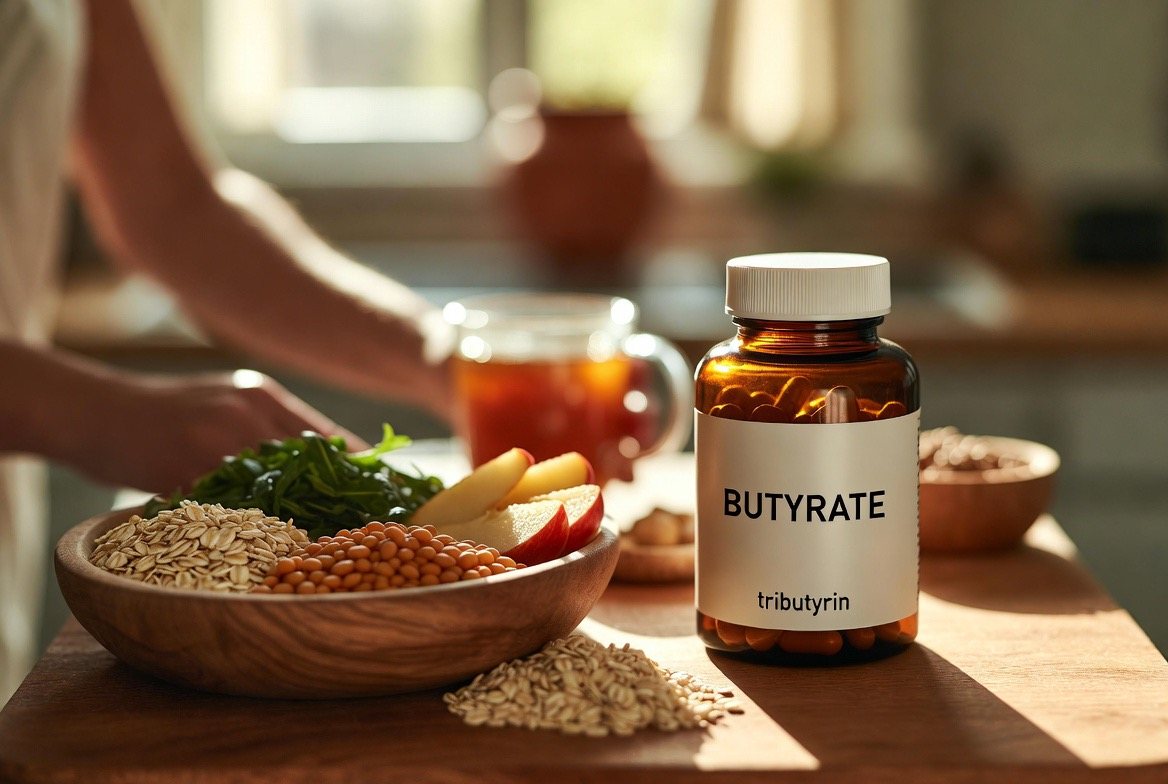
- The molecule is real and important; the pill is the open question. Butyrate made by your own gut bacteria fuels the cells lining the colon, tightens the gut barrier, and helps regulate inflammation — that endogenous biology is well established.1 Whether a swallowed capsule reproduces it is a separate, far weaker claim.
- Oral butyrate barely survives the trip. It is unstable in the upper gut and mostly absorbed or metabolized before reaching the colon, which is exactly where it needs to act. Tributyrin, a butyrate precursor, is designed to survive better — but the human data behind that promise is early and largely pre-clinical.6
- The best gut-disease trials are disappointing. A rigorous placebo-controlled trial of oral sodium butyrate in children with new inflammatory bowel disease (IBD) found no benefit,4 and controlled trials that delivered butyrate straight to the colon by enema have mostly come back flat.23
- IBS and metabolic signals are hopeful but small. Some trials report fewer IBS symptoms and modestly better metabolic markers with butyrate — but many use combination products or short follow-ups, so the effect is emerging, not proven.57 Butyrate is low-risk, but low-risk is not the same as effective.
- What butyrate actually is
- Why people supplement it — and the delivery problem
- Ulcerative colitis: even direct delivery mostly failed
- Oral butyrate in IBD: the rigorous trial came back flat
- IBS and metabolic markers: a hopeful, shaky signal
- Forms and dosing: sodium butyrate vs tributyrin
- The honest alternative: feed the bacteria you already have
- The hype: "heal your leaky gut in a capsule"
- The honest verdict
- References
What butyrate actually is
Start with the part that is genuinely well supported, because it is the foundation everything else gets built on — and often over-sold. Butyrate is a short-chain fatty acid: a small, four-carbon molecule produced in your large intestine when resident bacteria ferment the dietary fiber and resistant starch you cannot digest yourself. It is one of three main SCFAs, alongside acetate and propionate, but butyrate is the one that matters most for the gut lining specifically. Where acetate and propionate largely travel onward into the bloodstream and liver, butyrate is consumed locally, right where it is made.1
Its central role is almost startlingly direct: butyrate is the preferred fuel for colonocytes, the cells that line the colon. These cells derive the majority of their energy not from blood glucose but from butyrate in the gut lumen, oxidizing it to power themselves. That single fact underpins much of butyrate’s reputation. A well-fueled gut lining maintains itself better, and butyrate does more than feed those cells — it promotes the tight junctions that seal the barrier between the gut interior and the bloodstream, and it acts as a signaling molecule that damps down inflammation, partly by inhibiting enzymes called histone deacetylases and partly by engaging specific receptors on immune cells.17
This is why butyrate shows up in so many discussions of gut health, metabolic health, and even the gut-brain axis, and why low butyrate-producing capacity keeps turning up in the microbiomes of people with various diseases.7 All of that is real, and it earns butyrate a STRONG grade — as an endogenous molecule. But here is the caveat that governs the rest of this article: nearly all of that impressive biology describes butyrate made in place, by your own bacteria, in the colon, at steady low concentrations. It does not automatically follow that swallowing butyrate in a capsule reproduces any of it. A molecule being important is not the same as a supplement of that molecule being effective. Those are two different claims, and they have two very different levels of evidence behind them.
Why people supplement it — and the delivery problem
The logic behind supplementing is easy to follow. If butyrate is this good for the gut lining, and if many people (especially on low-fiber Western diets) produce too little of it, then why not just take it directly? Skip the fermentation, skip the fiber, deliver the finished molecule. That reasoning has driven a fast-growing market in sodium butyrate capsules and tributyrin softgels sold for gut healing, "leaky gut," IBS, and general wellness. The appeal is obvious and the mechanism is seductive.
The problem is pharmacokinetics — what actually happens to the molecule after you swallow it. Free butyrate is volatile, foul-smelling, and unstable in the upper digestive tract. When taken orally in an unprotected form, it is rapidly absorbed high in the small intestine and metabolized, so very little survives the long journey down to the colon, which is precisely the site where its celebrated effects on colonocytes and the barrier take place. In other words, the ordinary oral route tends to deliver butyrate everywhere except where the biology says it should go. This single delivery problem is the reason the supplement evidence is so much weaker than the mechanistic story, and any honest read has to start there.6
Two engineering answers have emerged. The first is colon-targeted or microencapsulated sodium butyrate, coated to resist the stomach and upper small intestine and release lower down. The second is tributyrin — a molecule made of three butyrate units attached to a glycerol backbone, which resists stomach acid and is cleaved into butyrate by pancreatic and gut lipases further along. A 2025 laboratory study of a commercial tributyrin (CoreBiome) using a simulated gut model found that roughly half the dose was hydrolyzed to butyrate in the small intestine while the remainder stayed intact and reached the colon, where it raised butyrate levels and shifted the simulated microbiome favorably.6 That is a genuinely encouraging bioavailability result — and it also flags the honest limit. It is an in vitro model, not a clinical outcome. It shows the molecule can arrive; it does not show that arriving there heals a disease or fixes a symptom in a real person. The gap between "the butyrate reached the colon in a test tube" and "the patient got better" is exactly the gap the human trials have to close.
A plausible molecule that reaches the right place in a lab model is a promising start, not a proven treatment. The whole reason trials exist is that delivery is not the same as benefit.
Ulcerative colitis: even direct delivery mostly failed
If the delivery problem were the whole story, there would be an obvious workaround: put butyrate straight into the colon and bypass the upper gut entirely. Researchers tried exactly that decades ago, using butyrate enemas in ulcerative colitis (UC — a form of inflammatory bowel disease that inflames the colon lining, and the condition where the "colonocyte energy deficiency" theory is most compelling). This is the cleanest possible test of the mechanistic hypothesis, because it removes the excuse that the butyrate never arrived. And the results are sobering.
In a controlled trial published by Steinhart and colleagues in 1996, 38 patients with active left-sided UC were randomized to nightly enemas of sodium butyrate or saline placebo. Clinical improvement occurred in 37% of the butyrate group versus 47% of the placebo group — no significant difference, and if anything numerically favoring placebo.2 A parallel literature of short-chain fatty acid enema trials from the same era produced trends and hints but rarely a clear, replicated win. When a 2021 systematic review by Jamka and colleagues pooled the randomized controlled trials of sodium butyrate enemas in IBD — eight studies covering more than 200 patients — its conclusion was blunt: the current evidence is limited and does not support the use of butyrate enemas in ulcerative colitis, with no reliable data at all in Crohn’s disease.3
This matters far more than a single failed product, because it undercuts the core assumption of oral supplementation. The enema trials delivered butyrate directly to the inflamed tissue, at pharmacological concentrations, and it still mostly did not reliably outperform placebo. That does not prove butyrate is useless in the gut — the endogenous, continuous, bacterially-produced version may work differently from an intermittent bolus, and UC is a complex disease. But it does mean the simplest version of the supplement pitch (more butyrate at the gut wall equals healing) has been tested about as directly as possible and has largely come up short. Any oral supplement has to clear a bar that even direct delivery struggled to clear.
Oral butyrate in IBD: the rigorous trial came back flat
Given the enema results, the oral IBD data is unsurprising but still worth stating plainly, because it is the most rigorous oral-butyrate trial in a defined disease. Pietrzak and colleagues ran a prospective, randomized, placebo-controlled, multicenter trial of oral sodium butyrate as an add-on to standard therapy in children and adolescents with newly diagnosed inflammatory bowel disease, published in Nutrients in 2022.4 Patients aged 6 to 18 with colonic Crohn’s disease or ulcerative colitis received either 150 mg of sodium butyrate twice daily or placebo alongside their real treatment, and were followed for 12 weeks.
The result was flat. At 12 weeks, most patients in both groups had reached remission — because standard therapy works — but there was no significant difference between the butyrate and placebo arms in remission rate, disease activity, or the median of fecal calprotectin, an objective marker of gut inflammation.4 Butyrate added nothing measurable on top of proper care. To its credit, the trial also found no adverse events, which is consistent with butyrate’s generally benign safety profile. But "safe and did nothing extra" is precisely the finding that should temper enthusiasm. This is a well-designed, placebo-controlled, multicenter test in an active disease where the mechanistic case for butyrate is strongest — and the supplement did not move the needle. It is the single most important data point for anyone considering an oral butyrate capsule to treat gut disease, and it points the same way the enema trials do.
in remission or calprotectin
oral sodium butyrate, pediatric IBD
vs 47% on placebo (n.s.)
Steinhart 1996, ulcerative colitis
found no support for UC
Jamka 2021 systematic review
IBS and metabolic markers: a hopeful, shaky signal
So is it all negative? Not quite — and this is where honesty cuts both ways. Move away from the hard endpoints of inflammatory bowel disease and toward the softer, symptom-based world of irritable bowel syndrome (IBS — a functional gut disorder marked by pain, bloating, and altered bowel habits without visible damage), and the picture becomes more hopeful, if far less rigorous. Several small trials of colon-targeted or microencapsulated butyrate report improvements in IBS symptoms such as abdominal pain, bloating, and stool consistency, and butyrate’s role in modulating gut motility and visceral sensitivity gives that a plausible mechanism. A 2025 placebo-controlled trial of calcium butyrate alone in 51 children with IBS reported a markedly higher rate of symptom relief than placebo,8 and a 2026 placebo-controlled trial of microencapsulated sodium butyrate in adults with type 2 diabetes who also met IBS criteria found significant reductions in abdominal pain and bloating.9 Both are single-center and small, but they are butyrate-alone designs, which is exactly what the field has been short of.
The catch is in how those trials are built. A representative example is the Gąsiorowska trial framework, a randomized, double-blind, placebo-controlled study in adults with IBS — but it tests colon-targeted microencapsulated sodium butyrate combined with probiotics and a prebiotic fiber, not butyrate alone.5 That combination design is common in this space, and it creates an unavoidable interpretation problem: if the product helps, you cannot cleanly attribute the benefit to butyrate rather than to the probiotics, the prebiotic, or the interaction of all three. Add small sample sizes, short follow-ups, and symptom outcomes that are inherently sensitive to placebo, and the IBS evidence lands as EMERGING: a real, repeated signal worth taking seriously, but not clean enough to promise a result.
The metabolic story sits in a similar place. Butyrate influences insulin sensitivity, appetite signaling, and low-grade inflammation in mechanistic and animal work, and narrative reviews highlight its potential in obesity and type 2 diabetes.7 A handful of small human trials report modest improvements in markers like blood-sugar control or gut symptoms in metabolic patients — the 2026 type 2 diabetes trial above also reported small reductions in HbA1c and insulin resistance alongside the symptom relief.9 But these are early, often underpowered, single-center studies with short follow-ups. The fair reading across IBS and metabolic health is identical: promising enough that the research is worth doing and a low-risk trial is defensible, nowhere near strong enough to sell butyrate as an established fix. "Emerging" is doing exactly the work it is supposed to do.
When you see a positive butyrate headline, the single most useful question is: what was actually in the capsule, and what was it compared against? A huge share of the encouraging human data comes from products that bundle butyrate with probiotics and prebiotic fiber, tested against an inert placebo — so a win cannot be pinned on butyrate itself. And the delivery form matters as much as the dose: unprotected, colon-targeted, and tributyrin are three different interventions. The Manual maps the gut and postbiotic interventions against each other with the evidence graded and the delivery details pinned down — so a claim about "healing the gut lining" gets held to the same standard as any drug. See the Manual →
Forms and dosing: sodium butyrate vs tributyrin
If you have read this far and still want the practical landscape, here it is — with the standing caveat that "here is how people take it" is not the same as "here is a proven protocol," because the outcome trials to anchor a dose barely exist. The forms fall into three buckets, and they are genuinely different interventions.
Unprotected sodium (or calcium/magnesium) butyrate. The cheapest and most common. It supplies butyrate as a salt, but without enteric coating it is largely absorbed and metabolized in the upper gut, so relatively little reaches the colon. This is the form with the weakest theoretical case for local colonic effects, whatever the label promises.
Colon-targeted or microencapsulated sodium butyrate. Coated to survive the stomach and upper small intestine and release lower down. This is the form used in most of the more credible IBS trials, typically in the range of a few hundred milligrams to around 1 to 2 grams of butyrate per day, often split into two doses.5 The engineering is the point: it exists specifically to solve the delivery problem, and it is the form to look for if you are going to try anything.
Tributyrin. The precursor approach, designed to pass the stomach intact and be cleaved into butyrate further along, delivering a meaningful fraction to the colon in laboratory models.6 Mechanistically the most elegant, and the one generating the most current research interest — but also the one where human clinical-outcome data lags furthest behind the bioavailability promise. Choosing tributyrin today is a bet on a plausible delivery mechanism, not a verdict from finished trials. Across all three forms, butyrate is generally well tolerated; the main real-world complaints are gastrointestinal (loose stools, cramping, and an off-putting smell with poorly-coated products) rather than anything dangerous.
The honest alternative: feed the bacteria you already have
There is a quieter point that the supplement framing tends to bury, and it deserves its own place. The most reliable way to raise colonic butyrate is not to swallow butyrate — it is to feed the bacteria that make it. Butyrate-producing microbes thrive on fermentable fibers and resistant starches: the material in legumes, oats, barley, whole grains, onions and leeks, slightly-green bananas, and cooked-then-cooled potatoes and rice. Feed those bacteria and they produce butyrate continuously, in place, at the gut wall, at the low steady concentrations that the entire endogenous-biology story is actually built on.17
This is not a throwaway "eat more fiber." It is the logically stronger intervention, because it produces butyrate the way the human body evolved to receive it — distributed along the colon, generated by a diverse microbial community, and tied to all the other benefits of a fiber-rich diet that a butyrate capsule cannot replicate. The mechanistic reviews that make butyrate sound miraculous are, overwhelmingly, describing this butyrate. A supplement is an attempt to shortcut a system that the shortcut cannot fully reproduce. For most people with a functioning colon and no specific medical reason to do otherwise, the fiber route is the better-evidenced, cheaper, and lower-risk way to get the exact molecule the supplements are selling.
The hype: "heal your leaky gut in a capsule"
Now the claim to reject. Butyrate is routinely marketed as a capsule that heals a leaky gut, reverses gut disease, and hands you all the benefits of the fiber-fed molecule with none of the fiber. It is a tidy pitch, and it is not supported by the rigorous human evidence. The most rigorous oral-butyrate trial in an active gut disease found no benefit over placebo,4 and even direct colonic delivery by enema mostly failed to beat placebo in ulcerative colitis.3 There is no strong controlled trial showing that an oral butyrate supplement reliably repairs a compromised gut barrier or reverses established gut disease in humans. Framing it that way is HYPE in the technical sense: a claim far beyond what the controlled evidence supports.
The subtler version of the hype is the appeal to mechanism — "butyrate feeds your colon cells and seals your gut, so of course the capsule works." But that sentence smuggles in the very thing that has to be proven. It describes what endogenous butyrate does, then quietly transfers the credit to a pill that mostly does not arrive at the same place in the same way. Mechanism is not outcome; that is the entire reason placebo-controlled trials exist. Butyrate was given fair tests in the settings where its mechanism is strongest, and it repeatedly failed to add measurable benefit. The correct posture is neither "miracle" nor "scam," but the unglamorous middle: an important natural molecule whose supplement form has a real but thin and mostly disappointing human evidence base, sold with a confidence the data have not earned.
The honest verdict
Put it together and butyrate resolves into a molecule that is genuinely central to gut health and a supplement that is genuinely unproven — and holding both ideas at once is the whole skill here. The endogenous biology is strong: butyrate made by fiber-fed bacteria fuels the colon lining, supports the gut barrier, and helps regulate inflammation, and it earns a STRONG grade as a molecule.1 The oral supplement is a different and weaker claim: delivery is a real obstacle, the most rigorous disease trial came back flat, and even direct colonic delivery mostly failed — so the supplement grade is WEAK, not because butyrate is unimportant but because swallowing it has not been shown to reproduce the biology.43
The genuinely hopeful territory is narrow: IBS symptoms and some metabolic markers, where small, often combination-product trials report real but hard-to-attribute benefits — EMERGING, worth watching, not yet worth promising.57 And running under all of it is the most useful practical fact in the article: the most reliable way to raise colonic butyrate is to eat the fibers that let your own bacteria make it, continuously and in place, which is exactly the butyrate the impressive research describes. Butyrate is low-risk enough to be a reasonable experiment for a specific problem like IBS in the hands of someone who chooses a colon-targeted or tributyrin form with clear eyes — and nowhere near proven enough to justify the "heal your gut in a capsule" language draped across the category.
This is not medical advice, and gut disease is a place where the boundary matters. Whether butyrate has any role in your IBS, IBD, or metabolic care, in what form, and whether better-evidenced options should come first are clinical judgments that belong with a professional who knows your history — not with a supplement label or an article. Our wider coverage makes the same point from other angles: a powerful mechanism plus thin, heterogeneous human data is a reason for measured curiosity, never for confident claims. Read butyrate for what it is — a crucial natural molecule whose supplement form has not caught up to its biology — and let the trials, not the pitch, set your expectations. You can browse the wider evidence base on gut and digestion and our full Evidence Radar for how we grade claims like these.
References
- Hays KE, Pfaffinger JM, Ryznar R. The interplay between gut microbiota, short-chain fatty acids, and implications for host health and disease. Gut Microbes. 2024;16(1):2393270. DOI · PMID 39284033
- Steinhart AH, Hiruki T, Brzezinski A, Baker JP. Treatment of left-sided ulcerative colitis with butyrate enemas: a controlled trial. Aliment Pharmacol Ther. 1996;10(5):729-736. DOI · PMID 8899080
- Jamka M, Kokot M, Kaczmarek N, Bermagambetova S, Nowak JK, Walkowiak J. The Effect of Sodium Butyrate Enemas Compared with Placebo on Disease Activity, Endoscopic Scores, and Histological and Inflammatory Parameters in Inflammatory Bowel Diseases: A Systematic Review of Randomised Controlled Trials. Complement Med Res. 2021;28(4):344-356. DOI · PMID 33352566
- Pietrzak A, Banasiuk M, Szczepanik M, et al. Sodium Butyrate Effectiveness in Children and Adolescents with Newly Diagnosed Inflammatory Bowel Diseases—Randomized Placebo-Controlled Multicenter Trial. Nutrients. 2022;14(16):3283. DOI · PMID 36014789
- Gąsiorowska A, Romanowski M, Walecka-Kapica E, et al. Effects of Microencapsulated Sodium Butyrate, Probiotics and Short Chain Fructooligosaccharides in Patients with Irritable Bowel Syndrome: A Study Protocol of a Randomized Double-Blind Placebo-Controlled Trial. J Clin Med. 2022;11(21):6587. DOI · PMID 36362815
- Duysburgh C, Verstrepen L, Van Meulebroek L, Marzorati M. Tributyrin (CoreBiome) enhances butyrate levels and modulates the gut microbiota, barrier function, and immune response in vitro. Front Nutr. 2025;12:1712993. DOI · PMID 41473189
- Kalkan AE, BinMowyna MN, Raposo A, et al. Beyond the Gut: Unveiling Butyrate’s Global Health Impact Through Gut Health and Dysbiosis-Related Conditions: A Narrative Review. Nutrients. 2025;17(8):1305. DOI · PMID 40284169
- Cristofori F, Calabrese FM, Iacobellis I, et al. Calcium butyrate efficacy in pediatric irritable bowel syndrome: randomized placebo-controlled multiomics-based clinical trial. J Pediatr Gastroenterol Nutr. 2025;81(3):551-561. DOI · PMID 40635319
- Panufnik P, Więcek M, Szwarc P, et al. Effect of microencapsulated sodium butyrate on abdominal symptoms and carbohydrate metabolism in patients with type 2 diabetes: a randomized placebo-controlled trial. Sci Rep. 2026;16(1):17404. DOI · PMID 41974937